Sunday, 24 November 2013

Design your game item Hitman Absolution


The game that I will be talking about today is Hitman Absolution. Hitman is an action adventure, stealth game developed by IO Interactive and published by Square Enix. The game levels and missions are based on eliminating your target and making a clean escape. You can traverse through the level in whatever way you seem fit and can execute your mark in a number of ways. Hitman is all about killing your mark and then getting away but often times you have to kill other people as they are in your way. If you kill someone that is not your target you lose some points overall. I would like there to be a way to take out enemies without killing them.


I would like to add a stun gun to your arsenal. This would provide players with an alternative to handle guards instead of just killing them. Adding a non-lethal weapon to your kit would change the way you approached the level. Instead of killing every guard that is in your way you can incapacitate them instead. This would mean that you are not killing them and you will not lose points for non-mark kills. This would also make the game easier as you don’t have to find interesting and unique ways around the level. Instead of looking at the paths that the AI takes and then figuring out a solution you could just incapacitate everyone and you would be done.


I would like the stun gun in the game for new players but for the more experienced players I don’t think they should be able to have this ability. In Hitman there are two categories of difficulty, Enhanced and professional. Enhanced is an easier level of difficulty and the game will give you a helping hand while you are in the level. Professional category does not give the player any tip, hint or help in any way and the enemies are more alert. Hard and expert are difficult to play on as you are given no help and the enemies are smarter and more alert. Purest mode leaves you with nothing. You have no help, no guides, no HUD and only a crosshair. I do not want to take away from the challenge from the professional mode so I would only let Enhanced levels use the stun gun.


Adding a non-leathal approach to Hitman would add an interesting game mechanic and a new way to look at the level. This would make going through a level and only killing your target that much more achievable.

Saturday, 23 November 2013

Scripting Procrastination, Squirrel and Lua

This blog I will be discussing scripting and my experience with it. At the end of this blog you will know where I am with scripting in my game. To begin this blog it would be best to go over what scripting is and what it does.

My game currently is written in C++, a great general purpose and robust intermediate programing language. C++ code is written, compiled and executed. When a line of code is changed in the program the entire program must recompile before it can be executed. Now this is fine for small console applications where the compile time is short. With larger applications like my game for example with precompiled headers, third party libraries, engine source files and my user source files the compile time of my game is quite lengthy.  Recompiling time has started to get around a minute in some occasions. If you are working with a full industrial engine the compile time is not worth it. There must be a way to compile code on run time. Scripting provides this functionality.

Scripts are small programs written in text style files and compiled at run time. You can code these files separately from your engine and they will still compile. Scripts have two main functions within engines.

You can take variables from your sources code and use it within the script. For example you can write functions in a script and then call it in your C++ code. A function called foo is written in the script. The function takes in variables and returns a value. In your C++ code you would call this function and send it the variables you want it to work with. The function will return a value after it is done its execution. If the function is not returning the values you are looking for then you can easy change the function and you will not have to recompile your C++ code.
The second way to use scripting and the implementation that we are using in our game is calling C++ code from scripts. For example you have a GameObject initialization and it takes in variables to determine what it is. The function takes in the maya name, health, if it is a static or dynamic object, and if it is visible. In your script you call this function and send it the information for the object that you want to create.

Our GDW game requires scripting to be implemented in some way or another. It does not matter what scripting language you use as long as it is implemented. At the beginning we were looking at all of our choices: Angel script, Python, Lua and Squirrel were the ones that we initially looked at. We then narrowed it down to two Lua and Squirrel.

First attempt was Squirrel as we liked the language and though that it would work for our purposes. At the start the Squirrel was easy to install as it came with header and library files ready to go. But as we started to try and use it we found that the documentation was almost nonexistent and everything that we could find told us to use a third party library called Sqrat. After many attempts to implement it we scrapped Squirrel and went with our alternative.

Since the documentation for Squirrel was so terrible we were glad to see that there was documentation as far as the eye could see. This was a promising start indeed. When we tried to download and install it we realized that Lua is written for UNIX based system and we had a hard time creating the source and lib files. I spent a solid day trying to cMake the project just like tutorials said but my efforts were in vain. After a good session of fist a cuffs with creating the source files we finally found premade files. Now that we had Lua source files we could install it but when it came to using it we found yet again that everyone was using a third party library called LuaBind. After we got LuaBind installed we were able to get a console message on the screen and that is all we have for scripting so far.

During this semester we spent a lot of time implementing scripting and have not had the result that we were looking at. It was decided that we would put it on hold while we turned our focus to gameplay. I am happy to say that yes we now have gameplay. Now just have to dance with scripting again… joy.

Overall scripting is great when used correctly (still have to figure that out) and can make developing games easier. Again this is just another tool for you to use to make programs and games better.

Friday, 22 November 2013

Crafting a Dekonstruer #2 Mark Of The Ninja

I have passed the second gate and now it is time to get my blog on. Let the button mashing begin!


To start this blog we are going to be looking at the side scrolling stealth game Mark of the Ninja and breaking it down to its bits and pieces. I am going to talk about the game design atoms and tell you why I think this game is the benchmark for all stealth games.


Players:

Mark of the Ninja is a single player game that follows a nameless ninja in the modern era. The game starts off with an armed assault on the ninja’s dojo. This is where the player comes in as the nameless ninja on his assignment. As this game is exclusively single player with no multiplayer at all players play against the game system. This type of player interaction pattern would fall under “Single player vs. game”. The game consists of levels or mission objectives and your progress in the game is saved when you complete the level. There are checkpoints if you die in the level but you can’t save your progress mid-level and come back to it. Some players will not like this but I find that the levels are just the right size so that this is not a problem.


Objectives and Goals:

Mark of the Ninja is set in the modern era but where clans of ninja still exist. As the assault on the dojo is going on the nameless ninja protagonist was resting after receiving a tattoo. The tattoo that was given to him has power and a legend attached to it. The ink comes from special flowers that increase his senses and reflexes. The tattoo is a double edged sword, as the ninja will slowly descent into madness and ultimately committing seppuku. (Suicide by self-disembowelment with a small blade known as the Tanto) (Side note I am also very interested in Japanese history, another reason why I like this game) The goal of the game is to investigate your attackers and deal with them before you suffer from madness. The player is trying to race against madness while gathering information and then outwitting the enemy.


Rules and Mechanics:

Mark of the Ninja is a 2D side scrolling stealth game with a lot of interesting and innovative game mechanics that makes it the best stealth game I have played. First off the stealth part of the game hinders on two things, not being seen and not being heard. When you are going through the level there will be bright and dark areas. To be stealthy you want to stay in the shadows as much as possible so that the enemies can’t see you. Sometimes it is too bright and no shadows to hide in, then you can break the light sources to make it darker. When you break lights it makes a loud sound that will alert enemies. You have to mix not being seen and not being heard. 


When moving throughout the level you have to make sure that you are also quite as it will alert the enemies that you are near.  To help traverse through the level you are also given offensive items and distraction items. You can use offensive items to kill enemies from a distance or use the distraction items to distract them while you move past them. An example of an offensive item would be a swarm of locust that eat and devour an enemy so that there is no evidence. A distraction item would be a smoke boom so the enemy cannot see you while you move past them. Now for combat and assassinating enemies you have your trusty sword. When you are close enough to an enemy you press the left mouse button and a direction will appear near the enemy. If you move your mouse in the right direction you will complete a silent assassination. If you go the other way the enemy will make loud death sounds and others will be alerted to you. The game mechanics makes it the best stealth game that I have played.


Resources:

While you are in a level you have side missions that you can complete. If you complete them you will get tokens or honor to unlock skills and upgrades. The player resives points for using tatics throughout the level such as silent assassinations, hiding bodies and not being spotted. At the end of the level the score is added up and get honor for passing a certain number. Players can then spend their honor in three sections: skills, distraction items, and attack items. By progressing thought the level and collecting as many points as possible you can upgrade all the aspects of your character. With the side missions in each level they also have a type associated with them. If you complete three missions of a certain type you unlock a ninja suit. These suits change the way you can play the game. One suit lets you instantly kill an enemy when you click with your mouse and you can’t have distraction items. Another suit does not let you carry swords so you cannot kill enemies. Instead you are given two distraction items and when you run you don’t make noise. The different suits provide a new and interesting way to play the levels adding replay value.


Game States:

There are two states that Mark of the Ninja can be in. The first state is when you are selecting a level. When you select the level that you are going to play then it will bring you to the upgrade screen. Here is where you can spend you honor that you have collected from playing other levels and select the load out that you are going to play the level with. From here the level starts normaly with an opening cut scene to set the setting of the level.


Sequencing:

Mark of the Ninja is played in real time with no time limits within it. As for upgrades you have to unlock the base upgrade before you can unlock the upgrade to it.

Player Interaction:

Mark of the Ninja is primarily a single player game and as such there is not a lot of player interaction. The most interaction that the player has is with the game system. There is no players for to interact with.


Theme and Setting:

Mark of the Ninja is set in the modern era with a clan of ninjas called haiku. There is not a lot of stealth game out there that use ninjas. Ninjas are interesting and compelling characters as they are well known for their legends and mystery. It is this mystery that makes people so interested in ninjas. This helps to the player get emotionally connected to the character. Since you are a ninja it is fun to act like one and the way the players play the game changes to reflect this.


Mark of the ninja is my benchmark for stealth games with its great mechanics and art style. This is what draws the players in and then makes them interested in the story of the game.


Thursday, 21 November 2013

PVP Chishek's Elevator


This blog will be discussing the portal level Elevator by the steam user Chishek. If you are interested in playing the level you can find it here on the steam workshop. In this blog I will go over my thoughts on the level as well as discussing some of the design choices. I will give my opinion of the level and my own feedback on it. If you want to see my first run through the level you can watch the video.


To begin discussing the design choices we can start with the beginning of the level. At the start of the level you are presented with the end. Well that level was easy you are done you can see the end, but there is a glass wall blocking your path. I have seen a lot of portal levels recently start with a display of the finish in some way but it is blocked by something. This is a great to layout the levels overall goal. By starting near the end you are showing them the finish and they can work towards it knowing where it is.


The next part is where the level gets its name. When you place the cube on the button an elevator starts and you ride up to where is first puzzle starts. Now I love and hate this elevator at the same time. I love the fact that you are almost creating a cut scene like effect showing the puzzles that you will have to complete. It is a nice visual for the player and lets them see the entire level with one ride. I also hate this elevator as I found that it was too slow. 


It was cool to see the level that you will have to complete but I also was stuck in an elevator and could not start on the puzzles. The duration between the time the level started and the time that I was on the first puzzle was too long and I found myself waiting at times for the level to truly start. I like the design aspect of the elevator and it was a unique and interesting concept. From a gameplay design perspective I do not like it as the player has to wait too long to actually start the level.


Once you were done waiting for the elevator to finish you can finally start the first puzzle room. I found that the beginning puzzle was a little too easy as it did not take me long at all to finish it in my mind. For a beginning puzzle it does fit as it is one of the easiest in the level and does fit as the starting.


You can see from the video that I quickly look at the level and see the solution. I have talked to other people about this level and they said that yes it did take them a bit to find the solution to the puzzle. In the grand scheme of the level I agree what this puzzle should be the first one.


The second puzzle on the other hand I found to be one of the hardest in the level. To solve the puzzle you have to be aware of a mechanic of portal that not a lot of people know about. 


I know many people that have played this level that could not figure out that you can grab the cube from the other side of the wall. Now I did play a level prior to this that implied a mechanic like this so I was aware that it was a think but others could not figure out the puzzle. To introduce the game mechanic to the player you could have had demonstrated it to the player in a controlled environment. Once the player is introduced to the game mechanic, then the puzzle is fine.


On to the third puzzle and I have to say that I don’t think that this puzzle belongs in the level. I have just solved two puzzles that felt like good puzzle rooms, while the third puzzle feels like an entire level. The scale of the puzzle does not fit within the level as it feels like could act as a level on its own. The puzzle itself is interesting and not that difficult to solve it just take a lot of time to complete and here in lies another problem. I have completed tow puzzles and have gone for a while, now I have to complete a puzzle that feels like an entire level. I would have not put this puzzle in the level and instead would have made a smaller and more puzzle room like puzzle.


After you are done completing the level within a level you are put into a small puzzle that is not hard to solve at all. The puzzle might be there because there had to be some way to get back to the exit that was displayed at the beginning of the level. I did not get this problem but a friend of mine Jodo had a problem where the reflector cube was not there and he could not complete the level. He also did a review of this level where he discussed what happened to him check it out here. I don’t feel like the puzzle needs to be in the level and would remove it completely. I feel like the level was too long and after the third puzzle I felt like the level should have been over.


The Elevator is a promising level with some good display of game mechanics. The first and second puzzles were great and set a good pace for the level. The third puzzle was overwhelming in size in the beginning but just takes some time to complete. The fourth puzzle for me should be scraped as it did not have the same feel at the other puzzles. When you are going up the elevator you are not told about this puzzle and I feel like it is unnecessary. To improve the level I would introduce the second puzzle’s game mechanic in a controlled environment so that players will not just get frustrated. I would also take out the fourth puzzle completely as it does not feel like a part of the level. I did not see it while I was going up the elevator so I also feel a bit lied to as the level was displayed to me while I was on the elevator and once I thought I was finished but there was one more puzzle that was not challenging but time consuming. 
 

Wednesday, 20 November 2013

Entity Component System - A Breath Of Fresh Air

This week was a big week for me in many aspects. My game studio’s game just made a big milestone which lifted our spirits and helped subdue the game burnout. Also this week a brand new coding design was dropped on us with no warning. After working on our game for the past eternity I was starting to find a lot of flaws and headackes with the way I has to use code. Using higharcal design with a base game object is starting to get stale and inefficient in my opinion. If I have to do anything with the class “GameObject” it will be too soon. Any way enough venting, the design that was brought to my attention is called the “Entity Component system”. This design system is based around the entity and component object. The entity object just has an identification ID and a list of components. A Component is just a container for data. It is time to get into the details of what makes this system a breath of fresh air for me.

Entities and Components


The Entity Component System (ECS) is based on you guessed it entities and components. Entity is a general purpose object that makes up every object in your game. You could think of an entity as a GameObject. The entity class just has an identifier and a container that stores components. A component is just a storage container for data. Here is a quick design to see what a base entity and component would look like in code. [entity and component code here]
Unity an Example of ECS
Entities and containers do not have logic in them they are just used for data. All the game logic will be handled by component managers which will be covered later. Now this might be a hard concept to understand and some of my studio members are still not completely sure how this works. It is easier to understand visually with an example. The game engine Unity is based on this entity component system, and is a great example of using this design graphically. If you were to make a new entity in unity it would create a new blank entity with a unique identifier. This could be a name or a number it does not matter it is just a way to identify it from all the others. The entity would not have any components added to it. If we wanted to make this entity visible we would add a renderable component to the entity. This would then make the entity render able. If we wanted this entity to be a dynamic object then we would add a physics component to it so that the physics system would recognize it. To add them with a GUI you could just drag and drop the components into the entity and they could take effect.

 class Entity{  
 public:  
      virtual ~Entity(){}  
      void addComponent(Component* pComponent){  
           components.push_back(pComponent);  
      }  
      virtual void update(){}  
 private:  
      Entity(unsigned int id) : ID(id){}  
      unsigned int ID;  
      std::vector<Component*> components;  
 };  
 class Component{  
 public:  
      Component();  
      virtual ~Component(unsigned int pType): type(pType){}  
      virtual void update(){}  
 private:  
      // here is where you put all of your data and vars  
      unsigned int type;  
 };  

Systems

A system or manager would query through the entities and check to see if they have a specific component. If the enmity says that it has it then it will give the component to the system and the system will apply its logic to the component. An example of a system like this would be a rendering system. To make an entity renderable you would add the renderable component to it. When the rendering manager goes through all of the entities and asks if they have the renderable component the entity will say yes because the component was added. Once the entity confirms that it has the component then it will send the component to the manager where it will be rendered. But how does the renderer render a component? The renderable component could have a list of vertices stored in it. When the render manager takes the component it would render the vertices to the screen. This is how systems, entities and components communicate and function.

Igniting the Fire Again

I have wanted to make an engine framework for a long time but have never had the motivation to do so. In my second year I had to make an engine framework and at the start I was enjoying making it, but then game code came and pooped on everything and made it a complete mess. After that I have not had the motivation to make an engine framework. Now that I understand this design style it has motivated me to want to make an engine framework again. My first year second semester 2D game was a game that I enjoyed making with a base library that one of my professors threw together. I want to make a 2D engine that would have made making that game a lot easier. It would be a good way to use all of the knowledge that I have gathered since and use it. It would be nice to look at my 2D engine and the first year me could understand and use it easily and effective. Now all I have to do is find the time =/


Monday, 18 November 2013

Domain Specific Language (DSL) and AI

The time has come for me to write another blog. This blog will be talking about the presentation that we say in class called “Flirting with the dark side” and had to do with Doman Specific Language (DSL). If you want to download the slides from the presentation you can get them here. All right topic confirmed… words incoming.

Domain Specific Language (DSL):

DSL or Domain Specific Language is a language that is specialized to solve particular application problems. These problems all have some sort of class or type in common. Another way to put it is a language that is great at solving a specific class of problems. DSL is designer friendly as the code is and the language is higher level language and does not need to be handled by a programmer. This means that designers can code something like AI without the assistance of multiple programmers for implementation. DSL is like a declarative file format as you normally state things happen. You do not have to worry about managing the memory and everything else that the programmer does, instead all you have to do is state how things are. DSL files could be thought of as a smart file that has a list of declarations.  So what does DSL look like? This is the example for DSL code used in the presentation.

if $Aim -> is of class Huge Ship
      if $distance > 3500 AND $distance < 20000
       if [THIS] -> fire missile $Missile on $Aim
        $Missilesfired.strength = $Missilesfired.strength + $Damage
        [THIS] -> set fire missile time difference to 16 ms
        $defend = random value from $Value.def2.min to $Value.def2.max - 1
        [THIS] -> interrupt with script '!plugin.fightcommand.defmove' and
          prio $Prio: arg1=$defend arg2=$Aim arg3=null arg4=null
        gosub Defensive.Definitions
      end
   end
end

Using DSL for AI and High Level Languages:

DSL is great for AI as it makes it easier to implement when the implementation is near the domain of the problem. DSL is also a higher level language so it does not come with the same concerns as lower level languages. There is no need to manage memory or how the code will work together. When you eliminate the lower level concerns then the language before more designer and artist friendly. Not everyone on team wants to worry about the lower level concerns. Designers and artist can work easier knowing that there will not be any issues while working with lower level code. AI is usually done by solving a limited set of problems with a small set of well-known solutions. With fewer issues in the implementation, the more AI issues can be solved.

DSL Making Your Own Language and Compliers:

As stated before DSL is a higher level language and comes with its own benefits. You can avoid memory management, complex syntax, and complicated undefined behaviors. This makes it so that more people can work with the language and does not need a programmer to implement it. So how would you implement DSL? For one thing you don’t have to make your own language. Creating compilers, interpreters, virtual machines, garbage collectors, and parsers are all too complicated. Instead we can use pre-existing languages like XML, JSON, and plain text documents. This implementation is easier for artist and designers to grasp and work effectively.

Guidelines for creating a DSL:

To create a DSL you want to take the logic that is coded into your engine by the programmer’s and use it outside of the engine in a simpler context. Take all of your logic code from the core game engine and use it outside of the engine. This is also called scripting. You can use DSL and scripts to run the pick and choose the logic code that you are going to use at any point in time. This makes it easy for designers to use the tools that are in the core game engine and use them in a versatile way. To make your DSL you must know what you are aiming to solve and solve just that problem. Making system for one purpose only make you code nice, neat and organized. When code is clean it is easier to understand, go thought and most importantly debug. One phrase that stuck with me from the presentation is “Minimal Syntax, Maximum Power”. As a programmer myself I like the complex syntax of c++ or java and had a hard time getting used to languages like python with minimal syntax. The less syntax the more powerful the code is. I have not thought about that before but I am stating to understand what this statement means. The more syntax there is the more you feel constricted to the style but with less syntax you get more freedom and that can make code more powerful.

Some closing tips:


I liked the statement “Keep low level logic in low level code”. There is no point in scripting code game engine mechanics in something like lua or squirrel as they are not fit to handle the logic. But you can use something that I like to call “designer logic” with higher level code. Gameplay and how the designer thinks are great for higher level code as it has the capability to handle it and make is easier on the implementer. One last closing tip that I took away from this is that you can create and deploy multiple DSL it does not have to be just one. A DSL should handle a specific problem and that is it. Making code cleaner is always the best. 

Sunday, 17 November 2013

Crafting a Dekonstruer #1 XCOM: Enemy Unknown


This weekend I found some time that I could take to sit down and bash my keyboard, in hopes of making that XP number rise. Let the face rolling begin!


To kick start this blog we are going to be looking at the strategy game XCOM: Enemy Unknown and breaking it down to its bits and pieces. These game atoms are the core of the game and make it one of my personal favorite strategy games.


Players:
XCOM is primarily a single player game but it still has a separate multiplayer mode where players can try to out play and out think their opponents. Players start off a multiplayer game by first creating a squad that can consist up to six members. With a pool of points use them to create a squad by spending them on soldiers and gear. Once they have created a squad then players take turns commanding their individual squads to defeat their opponents. This type of player interaction pattern would fall under “player vs player”.


XCOM has multiplayer but it is overshadowed by its great single player experience. The single player mode is just that, single player where the player plays against the game system, in order progress though the story and complete the game.

Objectives and Goals:
XCOM is set in the near future during man’s first contact with alien life forms. The player is put in charge of an elite military organization with no tires to any countries. The Goal of XCOM is to protect humanity from its first encounter with aliens while advancing humanity. The main goal of XCOM is outwit and find a solution to humanity’s crises. There are other side goals in XCOM such as research and advance human technology, create and construct new technology with the new research, capture and take back control of aliens landing site and so on.


Rules and Mechanics:
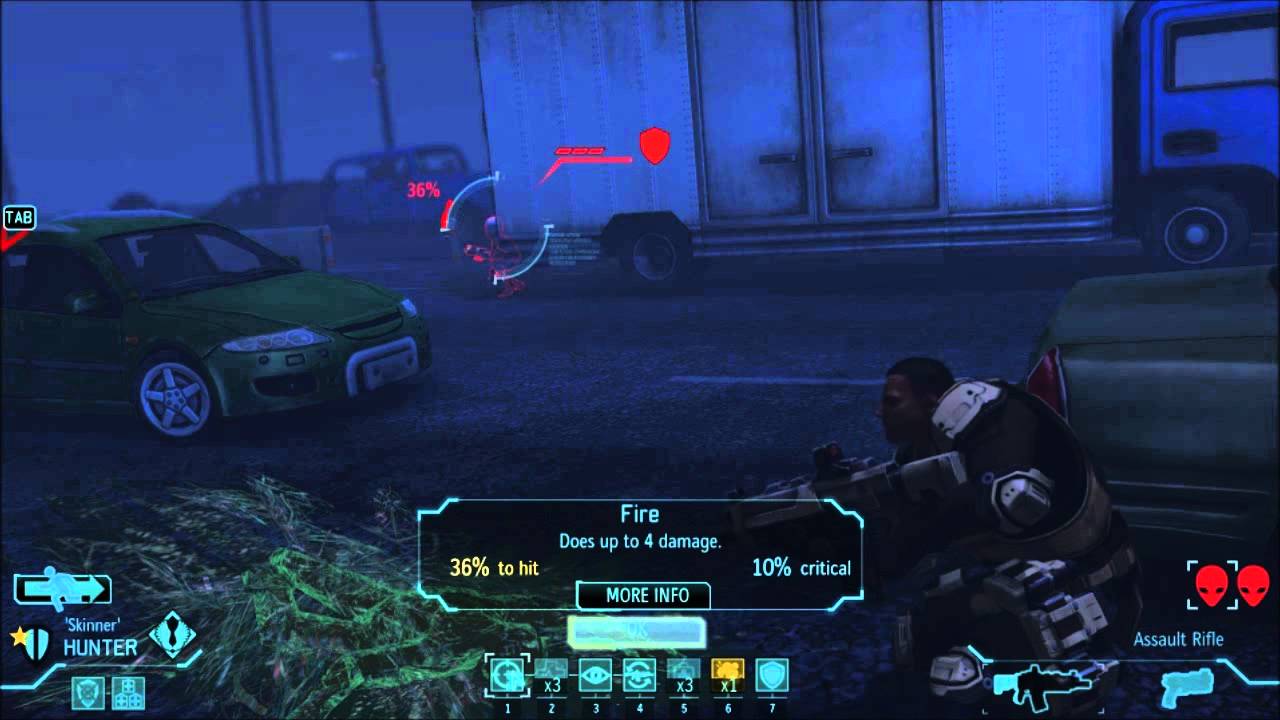
XCOM is a turn based tactical strategy game that focuses of positioning of your soldiers and tactics to defeat your enemy. Since it is a turn based game the structure of a turn is critical in making sure that the game is fun and balanced. In a standard turn each solder is given two actions that it can take. Actions mainly consist of moving, shooting and using skills. Soldiers have a set range that they can move with one action but you can also use two actions and move it twice the distance. You have to balance positioning and shooting while you are playing XCOM. Two actions per soldier per turn is the perfect number of turns and makes managing them important. There is also a cover system, that lets your soldier take cover to decrees the enemy’s chances of hitting you. There are two types of cover, partial and full cover. The two types of cover will affect the penalty to the enemy’s accuracy. These mechanics create the interesting gameplay that I have come to expect from an XCOM game.


Resources:
Besides XCOM being a great turn based strategy game it has its own organizational management where players have to manage the money, materials and human resources.  Players must manage the incoming money from supporting nations, to best equip your soldiers to fight the aliens. While you are getting money from supporting nations each month you must also manage relationships with each one of them. If a supporting nation is neglected in this regard then they will pull their support. With managing money and relations, you also have to manage resources that you find during missions such as enemy weapon fragments, Elerium, and the courses of dead aliens. You can use these resources with research or manufacturing to improve your fighting strength. The soldiers that you send off on missions are one of your most valuable resources. The more combat your soldiers have the more skilled and versatile they become. The difference between a recruit and a veteran is significant. Different soldiers different strengths while fighting. If you manage their strengths well then you will have a better squad as a result. The way you manage your resources greatly impacts your solder’s performance in the field and with that the way the game is played.


Game States:
There are a couple of game states that XCOM can be in. There are two main states base management and field combat. The combat state is where you have sent your soldiers off to a mission. While this state is going on you cannot manage your base until you finish the mission, retreat from the mission, or lose all of your solders. While you are in the combat state the game plays out like a turn based strategy game with each unit having two actions. This has been talked about above so it will not be covered again. If you are not in the combat state then you are in the base management state. While you are in this state you are at the XCOM HQ and will stay in this state until you pick a mission to undertake. In the managing state you can manage all of your resources as talked about in the resources section.


Sequencing:
In XCOM the combat state is handled in a turn based style. While you are in the combat state it will not change from a turn based style. When you have completed the combat state and change to the managing state the turn based style stays mostly the same. Instead of turns it is replaced with days and you can make as many actions as you want. As for order player actions there are order of events that must be completed inorder to unlock the next event. For example you must research something before you can start researching upgrades to it. Another example would be that you must research the technology in order to manufacture the technology.

Player Interaction:
XCOM is primarily a single player game and as such there is not a lot of player interaction. The most interaction that the player has is with the game system.


Theme and Setting:
XCOM is a humanity struggle game with everyone’s favorite… aliens! But with all seriousness it is one of thoughts first contact with aliens as they try to invade earth kind of games. This might not appeal to all players as the formula has been done countless number of times. To make the game successful it would have to do something to make it different from the standard formula. XCOM accomplished this with its detailed and in-depth combat system coupled with one of the best management system that I have seen in a long time. This is what draws the players in and then makes them interested in the story of the game.